PROCESS
Our company has been in the apperal accessories industry for over 10 years with own factory and hundreds of employees.
Efficient customization, Stable quality, Stable delivery time, Large quantity priority
Injection Molding
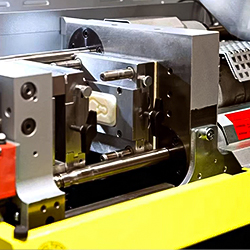
This process involves injecting molten plastic into molds to create the desired shapes, suitable for producing various plastic accessories such as buttons and zipper sliders. It is known for its cost-effectiveness and high production efficiency.
The raw materials used in injection molding are mainly plastic particles that can flow after melting, usually called plastic particles or plastic materials. These particles can be various types of plastics, such as polyethylene (PE), polypropylene (PP), polyvinyl chloride (PVC), polystyrene (PS), etc.
Heat Transfer
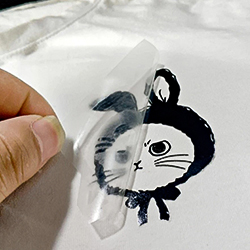
Utilizing heat transfer technology to transfer patterns or colors from heat-sensitive paper to fabric. This process is ideal for producing personalized and colorful apparel accessories, offering clear patterns and long-lasting colors.
The thermal transfer process has some advantages, such as high resolution, bright colors, and suitable for various materials. However, some limitations need to be noted, such as precise control of temperature, time and pressure, as well as adaptability to specific materials. Thermal transfer technology has a wide range of applications in customized products and small batch production.
Cutting and Sewing
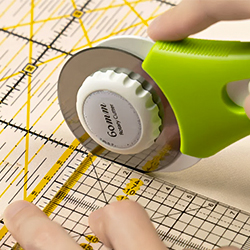
Traditional cutting and sewing of fabrics to create various shapes and designs for accessories like labels and linings. This classic process is known for its flexibility and high customizability.
Cutting is the process of cutting fabric to the desired shape and size following a pattern. This can be done by placing a paper pattern on the fabric and cutting it manually or mechanically using scissors or a cutter.
Sewing is the process of stitching together cut pieces of fabric. This usually involves the use of a sewing machine, but can also be done by hand. In the sewing process, it is necessary to pay attention to the choice of thread, the order of stitching and the stitch of sewing to ensure the quality of the final product.
Electroplating
Electrochemical deposition of a metal layer onto a surface, enhancing the metal's luster and durability. This process is suitable for creating metallic accessories like buttons with a strong metal texture.
The electroplating process refers to electroplating a specific coating on the surface of the aluminum sheet after a series of processes to obtain different functions and appearance effects.
The electroplating solution contains a certain concentration of metal ions, such as copper ions, nickel ions, chromium ions, etc., through the action of an electric current, these metal ions are reduced to metal atoms, and a layer of metal coating is deposited on the surface of the aluminum sheet. This step can not only increase the appearance of the aluminum sheet, but also provide good corrosion resistance and wear resistance.
Embossing
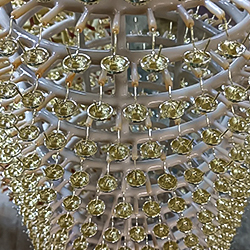
Embossing is a decorative process in which pressure is applied to a surface to create a pattern or pattern on the surface of a material. This process is usually used for paper, textiles, leather, metal and other materials decoration and product processing.
Before embossing, there needs to be a design of a pattern or pattern. This can be done through engraving, mold making, CNC machinery, etc. The design pattern is usually a pattern with a certain level of depth and detail.
After finishing embossing, some subsequent processing steps may be required, such as trimming, cleaning excess material, glazing, etc., to make the final product more aesthetic and textured.

Laser Cutting
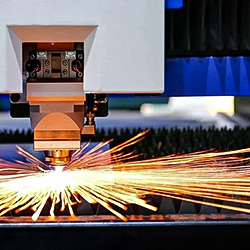
Precision cutting of fabrics using laser technology to create intricate patterns and contours. This process is suitable for high-precision accessory production, offering creativity and efficiency.
Laser cutting uses the high energy density of the laser beam to achieve the cutting of the material by converting the light energy into heat energy, causing the material to locally heat up and quickly evaporate or melt. The laser beam is generated by the laser and then focused through the lens and lens to form a very small and high-energy spot of light.
Hot Melt Adhesive
Bonding different fabric materials using hot melt adhesive. This process is suitable for the adhesive parts of apparel accessories, providing strong and fast adhesion.
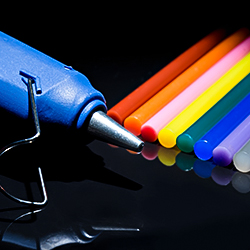
The hot melt adhesive process works by applying hot melt adhesive to two surfaces that need to be joined and then quickly gluing them together. Hot melt adhesive forms a strong bond after setting. This process does not require water, solvents or other chemicals, making it easier to operate.